All In The River’s Time
By Tom Bachert
The old man lurches forward with a slight groan, dragging the canoe bow securely onto the black pebbles of the long-forgotten gravel bar. Salty sweat blurs his fading vision as he reaches for the familiar gritty cork handle of his fly rod. The tattered remains of a small Elk-Hair Caddis flutters in the late afternoon breeze as he trudges through the ancient gravel towards the deep, cold pool at the tail of the gravel spit. His nose wrinkles at the sour smell of the spawned-out King salmon now feeding the gulls from its casket of shoreline rocks. Instinctively his eyes search the shoreline for any sign of lurking bear. Seeing none, he continues his trek towards the awaiting pool…a pool of promise. A pool seething with iridescent fins of Arctic Grayling long hidden from man by lonesome miles. A pool of memories, sealed forever by passing years.
The man pauses to rest and leans his weary bones against the bleached white skeleton of a large spruce trunk deposited on the gravel bar by the spring floods. “No sense in hurrying,” he muses to himself while staring blankly at the dark granite mountains through which the river has cut its course over the eons. “No hurry, all in the river’s time. No sooner, no later…all in the river’s time.” A slight breeze ruffles the white down growing on the tip of a fireweed flower stubbornly rooted at the base of nearby boulder, sending a few silky seeds into the air and reminding the man of the quickly approaching Alaskan winter. “When the fireweed turns to ash, time to make moose hash!” he laughs, recalling one of his late wife’s joyful proverbs about this time of year.
Throughout the many years they had traveled together, Katrina, his Russian-born wife, had always taken special delight in preparing each season’s first meal of moose, garnishing it with the garden’s bounty of potatoes and a dessert of fresh-picked blue berries. Katrina learned to prepare the rich meat with a proper reverence for both animal and taste-bud under the patient guidance of an Athabascan Indian woman who had taken the young, city-raised girl under wing. The beauty of the memory brings water to the man’s mouth as well as his eyes. Embarrassed with himself, he gruffly wipes his eyes and begins walking again.
Arriving at the head of the pool he stops to gaze into the depths of its swirling icy eyes. Its cobalt blue surface mirrors the rarified sky above and jolts his mind with reflections of his daughter’s eyes. She had been birthed into this world on a snowy winter night in a small cabin just a hundred yards or so back from the far bank of this pool, and these waters had cleansed her tiny, pink skin of the rigors of her mother’s labor. The swirling whirlpool of fear, confusion and ecstatic joy blurred the happenings of that night, but the pure blue of his new daughter’s eyes pierced the haze then, just as they burn through the fog of the years now. On that moonless night he declared her name to be Sapphire . During the years that followed her sparkling eyes added more glitter to his life than all the gold he had ever dredged from these lands. Ah, but like the shiny young fingerlings that spend their minnow-hood in this pool, she had long since left these waters to grow large in the distant sea.
The man shifts his gaze deeper into the pool towards a large, flat stone projecting at an angle from the submerged base of the cut-bank. The shadows of the depths obscure the details of the marble slab’s edges, despite the crystalline clarity of the icy water. His eyes strain against the current’s all encompassing movement, straining to detect the slightest movement of life. The autumn’s confetti of yellow and gold birch leaves drift through his field of vision, carried forever seaward by the river’s currents, yet his physical senses pick up no trace of the fish he pursues. Despite this lack of evidence, the man knows the fish is there, lurking among the shadows, waiting patiently in the pool’s rocky lair. It’s been there for years, growing larger and heavier with each passing season, its sail like dorsal fin fluttering like the most delicate butterfly wings amid the turbulence of the passing current. The fish has risen to his fly on several occasions, sucking heavily on his feathery offerings. It has even felt the sting of his hook more than once but has never felt the touch of his hand. The local Alaska natives believe that an animal must choose to give its soul to the hunter before it can be taken, and the man wonders if the same does not also hold true for this fish. “Perhaps you will choose me today…Perhaps today our souls will mingle.”
A loud splash downstream near the tail of the pool jolts the man from the depths of his thoughts. He looks up to see a beaver determinedly dragging a fresh Aspen bough through the persistent current. The animal, so preoccupied with its winter preparations, pays no notice to the man or the current’s constant tug. Despite this apparent lack of recognition, the current imparts an angle to the animal’s determined course, gently directing it to the snag-filled mouth of the feeder stream at the base of the pool. The beaver disappears into the incoming stream as if this was always its intended destination. The man cannot see beyond the mouth of the feeder stream yet his mind knows its rock-strewn course well. Indeed, it was the man’s back-breaking labor of dredging its cut banks and sluicing its gravels that molded it into its present shape. An ache in his knees recalls the hours spent standing in its icy torrents wrestling the working end of a suction dredge as it slurped and clawed at the bottom, churning up clouds of gray silt and puking mounds of black gravel into the top end of the sluice box.
During those endless summer days when the sun neither rose nor set, he labored, scarcely noticing the eagles soaring overhead and hardly tasting the food, which Katrina and Sapphire brought down for him. On particularly warm days, wife and daughter would beg him to take a break and join them for an afternoon of frolic and grayling chasing at the cabin’s pool, but he seldom accepted their giggling offers. There was gold in these rocks, and he was determined to find it! And find it he did, or at least so he had thought. It lay nestled behind boulders, embedded in the dark gravels and hiding between the rust-colored garnet layer and underlying bedrock. Tiny yellow flecks grew into slender, sand fingers between the sluice baffles. Occasionally, molten-shaped nuggets fell out of the garnet-laden gravels at the top of the sluice, waiting to be hand picked. His poke of gold grew while his young family’s poke of memories increased each day along the shores of the cabin’s pool. His wife Katrina had taken up the art of fly fishing when Sapphire received a Christmas gift of dyed feathers, caribou fur and a fly tying vise from T-bone Tom, the family’s upriver neighbor. On borealis-lit winter nights mother and daughter delighted in their colorful creations at the vise as much as they marveled at the metallic rainbow-painted fins of the Grayling that swallowed their winter creations under the summer’s midnight sun. Meanwhile, he delighted at the color accumulating on the bottom of his gold pans. Both palettes of hue painted their lives. Gold paved the road to good schools for Sapphire and comfortable living in nearby Fairbanks. However, it was the softer fish pastels that endured the inky blot of that sooty night and the smoky years that followed.
An almost imperceptible movement within the murky depths draws the man’s eyes. There, beside the slab rock, the fish moves. Its impossibly long dorsal fin floats among the current like the sail of a ghost ship. The fish’s silhouette rises from its shadowy lair. Its purple outlined spots grace its bronze sides and wink into the autumn’s light. The silky white underbelly flashes amid the murk as the fish sips some hapless insect from the surface. The fish sinks effortlessly back into the shadowy shroud of the depths with but a small dimple on the river’s surface left to testify of its passing. The man’s eyes search the current’s flotsam for any indication of the identity of the insect just eaten. Was it a tiny mayfly pupa struggling to burst forth with one last generation of new life before winter’s cold fingers seal the river? Was it the spent body of a caddis trapped in the surface film’s sticky coffin after a summer of flying free? The river reveals no answers to the man’s tired eyes.
The man’s nose twitches at the sweet scent of ripened labrador tea and blueberries drifting on a breath of a breeze floating down from the surrounding hills. The breeze ruffles the light tan caribou fur of the fly attached to the end of the man’s gossamer leader. Grasping the fly in his large sandpaper fingers, the man examines the fly. It is one of the few patterns he has learned to tie, a variant elk-hair caddis, made almost exclusively from caribou hair. It is equipped with tented wings, a flared head, and a thick body ornamented with gold ribbing. Katrina had shown him the steps for tying such a creation on a rain soaked spring afternoon. She had explained that it is a rather simple pattern but it floats high and is easy to see amid the confused ripplets of the river’s surface. It imitates an adult caddis fly, living free in the summer air after spending its juvenile years encased in a tomb constructed of river’s golden sands. When she described the caddis fly’s life cycle and the larvae’s propensity for constructing homes from the river’s sand, he had laughed and suggested that perhaps they could be trained to only select the gold dust to use in building their encasements.
“ Guess this tattered fly will work as good as any, “ the man mutters as he steps forward into the pool’s edge and prepares to cast. The back-cast loop straightens and the caribou fur softly whistles along its path to the far side of the pool. The trailing line is caught by the tugging current and the resulting u-shaped loop sends the fly skittering across the surface like a nervous female caddis eager to offload her eggs into the river’s water of destiny. The dancing fly entices no movement from the depths, so the man lifts the rod tip and sends the fly back into the air. The man performs a few quick false casts in order to dry the fly’s wings and contemplates his next strategy.
“It’s a bit late in the season for egg laying…perhaps a more subtle approach is in order.” The man allows the fly to settle onto the surface and then attempts to throw an upstream mend into the line so that the current will not drag on his offering quite so vigorously. Unfortunately his attempt to mend the line is a bit too energetic and the fly lifts off the water and settles into a back-eddy that will not carry it through the fish’s feeding lane. While the lifeless body of the fly drifts uselessly through the eddy, the fish once again materializes like a sulking submarine in the main pool and plucks something from the surface before disappearing back into the depths.
Feeling the frustration with his ineptness building in the pit of his stomach but not wanting to reveal it in his next cast, the man lifts the rod tip and lets the line flow into a backwards “D” off his right side. Just as the fly is about to again become airborne, he pushes the rod tip forward causing the fly to roll out behind him and then travel a circular path back out into the head of the pool. As it settles back into the swirling current he again throws an upstream mend, but this time with summer breeze gentleness. The still wet fly begins a sodden drift directly towards the gray shadows of the submerged slab of rock. This time its drift is unaffected by any current tugging at the trailing line.
The shadows of the pool begin to stir as the fly approaches. A dark silhouette emerges from the murk, taking on the sleek form of the fish as it angles upward towards the hairy offering. The surface boils as the fly vanishes from sight. The man leans back, setting the hook point into the soft mouth of disappearing fish. The rod tip vibrates for a second before bending towards the water as the fish struggles to return to the dark lair beside the submerged stone. The pressure of the rod turns the fish, changing tactics, the grayling surges towards the surface. It erupts from the water into the air spraying gem stone droplets into the autumn’s golden sunlight. The intensity of the display causes the man’s legs to stumble among the rocks. He back-pedals in an attempt to regain a purchase on the steep bank, but the marble-like gravel gives way beneath his boots, and the current’s cold grasp pulls him into the pool. The man raises his arms in an attempt to stem another aerial escape maneuver by the fish. This action causes his head to plunge beneath the entrapping currents.
Air explodes from his lungs as the frigid waters invade his waders and jab at his chest like boxing gloves of ice. For a moment the man thinks of releasing his grip on the rod and all the memories it embodies. Memories of Katrina and Sapphire’s laughter spilling out of the cabin’s walls while they tried to secretly assemble the rod whenever he left. Memories of his wife and daughter’s faces when they presented him with the product of their secret labors on that snowy Christmas morning. The thought letting go of all this is more painful than the watery blows pounding at his life. He clutches his rod’s cork handle even harder. The currents of the pool pull at his feet, dragging him ever closer towards the slab of marble implanted in the river’s heart. The slab that he at erected along the forest’s edge long before the river’s devouring currents had reclaimed it as one of its own. His boots bang against the slab’s algae-slicked surface, sending green strands of detritus into the currents and uncovering the letters he had engraved into it so many years ago through tear-blurred eyes and fingers numb with grief. The river pushes the man ever onward toward this pillar of fate. Through liquid haze, the man’s eyes behold the silt-tarnished letters, “KATRINA …” and the man’s soul leaps with a yearning deep within to forever join this submerged slab of stone. The liquid kaleidoscope engulfing the man rotates and the man again sees the thick smoke rising through the forest in the direction of the cabin site. Once again he feels the mining tools drop from his frozen hands as he sprints from the mine site down the snow clogged trail towards the flames devouring his home. His lungs again burn under the weight of the acrid smoke and his fingers tremble as they probe for life signs on the body sprawled in the crystalline snow. His ears wilt at the sounds of his daughter’s sobbing song emerging from beneath the blanket beside her mother’s corpse. Within the watery tomb the man’s mind screams. “Oh, let this be the day that river chooses me! …The day that it carries me home.”
The fish, angered by the hook’s sting and oblivious to the drama unfolding in the pool depths, streaks down river. It knows not its destination, but only that life lies in action. It bangs the stinging insect imbedded in its lips against boulders and flings it back towards the cobalt sky from whence it came. Yet through all these antics the insect maintains its aching pressure on the fish’s jaw. In desperation, the fish darts into the tangle of branches gyrating in the current beneath a dead-fallen birch. Suddenly, the pressure on its jaw becomes insurmountable, stopping any further progress of retreat. For a moment the fish lies motionless, held fast as the river and leaves wash past its scaled sides. Then driven by its lust for life the fish explodes into frantic flopping and writhing. Its lips of spongy flesh sear with the pain of fire and then go numb as the hook-laden insect pulls free. The river pushes the fish through the remaining tangles and the fish slowly settles back into the cloak of the rocky bottom.
The bend in the rod grasped by the man’s blue hand goes limp causing the man’s eyes to turn skyward. There, rising above the comforting shroud of hallucinogenic memories, burning through the enticing ghosts drifting in the river’s currents, a sapphire sun calls down to him. Unable to resists its song, the man pushes with numb legs against the entrapping stone and lunges towards the shimmering surface. His head breaks into the world of sunlight and cool air rushes into his parched lungs. With the rod still firmly embraced by his hand the man stumbles onto the rocky shoreline.
That night, warming his bones in the flickering campfire light, the man gazes into the colors painted on the river’s surface, reflections of the colors dancing in the sky above. As he reflects on the day’s happenings, a single Boreal Owl glides silently through the darkness and alights on top of the tall spruce tree standing sentry over the old cabin site. The man’s eyes grow heavy and he lies back into the warm folds of his awaiting sleeping bag. As he drifts towards sleep the owl begins a soft series of hoots. Within the bird’s soft serenade the man is sure he hears the words, “All in the river’s time …all in the river’s time.”
Showing posts with label BestWriting. Show all posts
Showing posts with label BestWriting. Show all posts
Wednesday, February 18, 2004


Friday, October 12, 2001
Bears & Bones
The ink of the night presses in upon us. Scrub and I huddle behind the shadowy hulk of my boat resting forlornly on its trailer in our driveway. Moments before we had been part of a different world….a world with televisions blaring harsh reports of terror and disaster to audiences of dirty dishes rotting in sinks. A world of kids complaining of unfair homework assignments. A world where beepers buzz electronic complaints issued from distant computers and electric lights obscure the Alaskan night. Scrub, being of the canine persuasion, never really fit into such a world and thus nuzzled me into taking our nightly walk in his world. Now we find ourselves in the darkness of the approaching winter listening with a mixture of fear and curiosity as teeth or claw shredded lumber and metal just outside our field of vision.
“Who goes there?” I demand, trying to sound like the confident king of my world. The night’s sudden silence was my only answer.
“Is it a bear?” I whisper to Scrub but his only response is a wet lick of my hand reassuring me that I really am the king and thus all must be right in the kingdom as far as he is concerned.
“Geeezz! I live in town. Certainly a bear wouldn’t be stalking me here. Then again this is ALASKA, and this certainly does seem to be the year of the bear.” It began in spring when I watched the “bear” market eat any hopes of an early retirement. This was followed by that June night when my boat broke down miles from the nearest road and those giant grizzly tracks marked off the area where my son and I would be pitching our tent. August had brought that whole family of bruins which raided our backpacks while chasing my son and I away from the best salmon fishing holes along the Talkeetna river. “Hmm, maybe the bears are even stalking me in my own neighborhood now.!
Gathering my courage I reach into my boat and retrieve a flashlight. Boldly I step forward into the darkness and stab at the light's switch. Much to my relief the batteries are still good and a bright yellow beam shoots into the darkness. My heart stops as I see two red eyes mirrored back at me along the edge of the cone of light but it restarts a moment later when I realize the eyes belong to my neighbor’s dog. His chain is tangled and his bowl of moose bones is stuck just out of reach under the corner of his wooden doghouse. Feeling much more like a king I walk over to him, untangle his chain and retrieve his food bowl.
Scrub and I continue our walk under the darkness of the approaching winter once again confident that all is well in the real world as long as one is not tangled in chains and has in possession a warm bowl of bones.
“Who goes there?” I demand, trying to sound like the confident king of my world. The night’s sudden silence was my only answer.
“Is it a bear?” I whisper to Scrub but his only response is a wet lick of my hand reassuring me that I really am the king and thus all must be right in the kingdom as far as he is concerned.
“Geeezz! I live in town. Certainly a bear wouldn’t be stalking me here. Then again this is ALASKA, and this certainly does seem to be the year of the bear.” It began in spring when I watched the “bear” market eat any hopes of an early retirement. This was followed by that June night when my boat broke down miles from the nearest road and those giant grizzly tracks marked off the area where my son and I would be pitching our tent. August had brought that whole family of bruins which raided our backpacks while chasing my son and I away from the best salmon fishing holes along the Talkeetna river. “Hmm, maybe the bears are even stalking me in my own neighborhood now.!
Gathering my courage I reach into my boat and retrieve a flashlight. Boldly I step forward into the darkness and stab at the light's switch. Much to my relief the batteries are still good and a bright yellow beam shoots into the darkness. My heart stops as I see two red eyes mirrored back at me along the edge of the cone of light but it restarts a moment later when I realize the eyes belong to my neighbor’s dog. His chain is tangled and his bowl of moose bones is stuck just out of reach under the corner of his wooden doghouse. Feeling much more like a king I walk over to him, untangle his chain and retrieve his food bowl.
Scrub and I continue our walk under the darkness of the approaching winter once again confident that all is well in the real world as long as one is not tangled in chains and has in possession a warm bowl of bones.
Saturday, September 01, 1990
Chena Tales
September, circa 1990
The First Time
Tonight I find myself camping on a lonely gravel bar. Its bed of dark, igneous stones scratched out over eons from the hills to the south by the fabled waters of the East Fork making their way towards the distant sea. The waters originate deep inside the tangled spine of granite ridgelines separating the Chena and Salcha rivers. Long before the first woman walked these valleys, the backbone’s jagged knuckles jabbed angrily upward at cobalt skies, propelled by turbulent upwellings deep in the earth’s raging mantle. This battle of mountain and sky raged unwittnessed for millennia, the mountain leaking blood of gold while the sky pummeled it with an arsenal of water and ice. By the time woman arrived to sooth the wounds, the battle was nearly complete. The backbone lay slumped over with age, its golden blood dribbling away into watery rivers. Some defiant bones still poke upward several thousand feet, and the beast’s hot subterranean heart continues to pump sulfur broth from a few pores, hinting of a possible counter attack, but for the most part it seems the war has moved elsewhere. The flesh and gore of this archaic battle make up my bed tonight. Upon this bed nestled beneath dark September skies swirling with colors from the earth’s pole I contemplate the landscape, its history, its smells, its future. I ponder my past, my future and yes, even my smell. Most of all, I contemplate the welcome warmth of my sleeping bag as my eyes drift off into the beckoning “other world” called sleep.
Burnt coffee floating on misty morning air wakes me. The warm, womb of my sleeping bag begs me to slumber but thoughts of moose and tangled antlers call to me louder than any alarm clock. The world outside the womb is cold and wet, still untouched by the warming fingers of dawn. Jeff Harrison, a coworker and friend, hands me a steaming mug of the bitter brew. Hot coffee stings my tongue and brings this world back into focus. My eyes clear and at long last behold the majesty of the East Fork country. Until now this landscape had been an ever-changing sketch in my mind’s eye. Its lines etched and tinted by panoramic storytellers wielding word-dipped paintbrushes. Stories of a land uncut by road, accessible only by boat, plane, or soggy boot. Stories of clashing antlers, claw-raked trees and clear, deep pools of finning grayling. Tales of crumbling cabins sinking into frozen forest floor graves, guarded by ghosts of gold seekers, bootleggers and fiery wolf eyes drifting among the fog. The East Fork, the least accessible of the five tributaries that come together to birth the Chena river.
Jeff had been here before so he is a bit less awe struck at being here than I. He and his cousin had taken a nice bull from the hillside directly behind this very gravel bar last hunting season. He owns a 16-foot johnboat with an attached jet unit outboard. A vehicle suitable in providing transportation into this country if also equipped with an adventurous heart and kindly river spirits. The river had treated us kindly last night, allowing us to steak through her snaky twists with mere inches of water cushioning our aluminum hull from the can-opener bottom. No logjams hid behind her many curves and no “sweepers” decapitated us as we sped through her narrow channels. Riding a jet boat in these “skinny” waters is a balancing game between speed and control. Speed is needed in order to plane over the shallowly covered rocks while control is necessitated by narrow curves and ever changing fields of obstacles. Ah, but the river smiled on us last night, sending an eagle to screech directions from above and an icy blanket of water to cool the jagged edges of her soul. Like a virgin she called me to enter but also like a virgin she will never allow me to forget the trespasses I commit in so doing!
June 22, 2001
Reunion
Like a seafarer of old returning to his young bride after a long voyage I return to the East Fork. My ventures have carried me to distant ports and I have cavorted with other lovely ladies, some even sisters and cousins of my bride. I have fought battles, looted king’s castles and spilled blood and tears on distant seas. Seas thrashing with the concerns of modern life, roaring with job responsibilities and shimmering with family intricacies. Through the best and worst of it, the East Fork’s deep, clear water eyes and the sweet singing of her riffles have echoed through my thoughts and dreams.
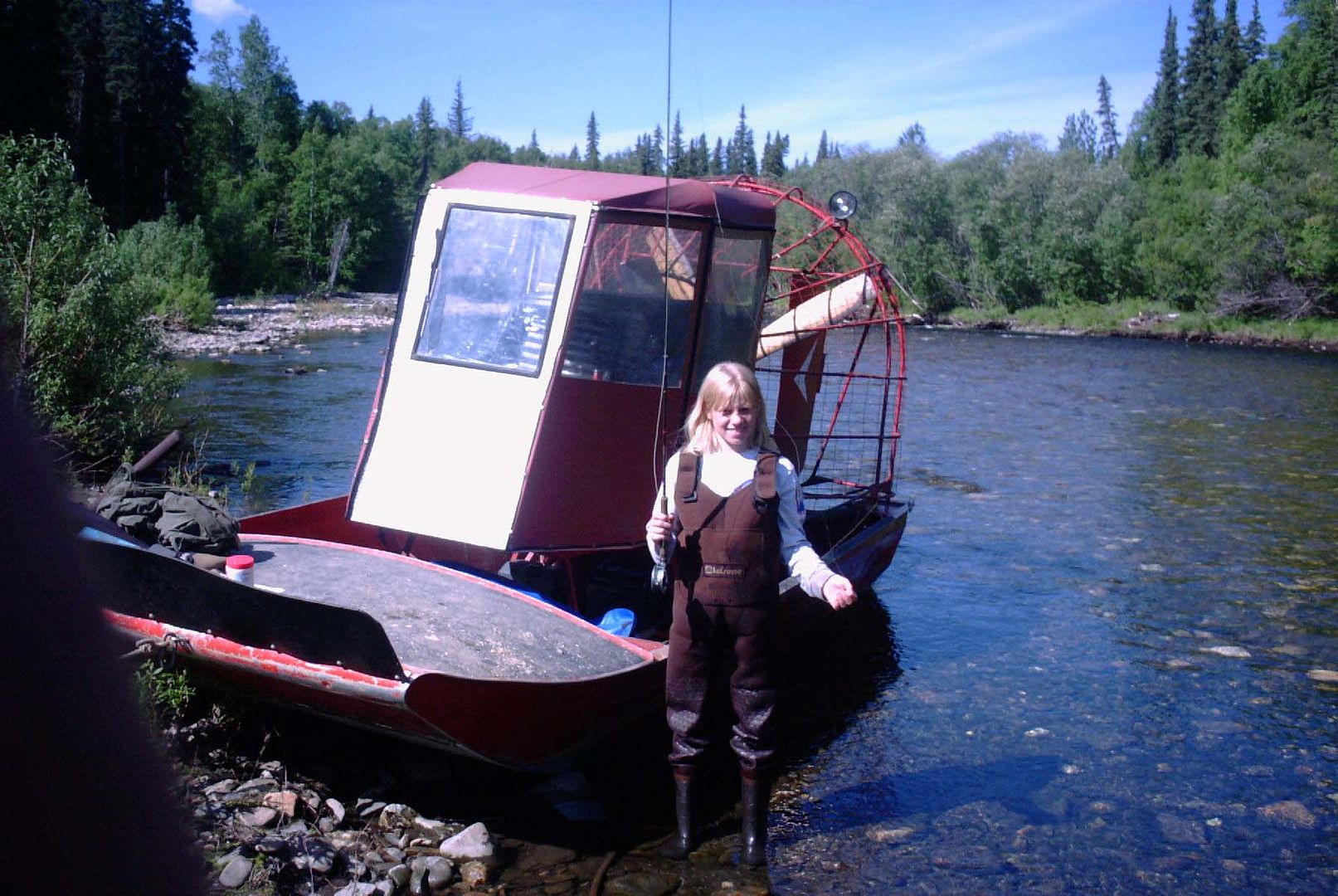
I present the East Fork with treasure and gifts won during my wanderings on these far off seas of complexity as I cross into her waters from that of her sister’s, the North Fork. I present to her a newly obtained air boat, the Sinful Cindy, which trembles briefly as the two sisters pause to mingle and bicker in swirling counter currents. However, I also bring a gift far more precious than the aluminum and steel of the Sinful Cindy. I bring the universe wrapped in the flesh and blood of my youngest daughter. Like a diamond Leah’s golden hair glistens in the river breeze. Her hair contrasts sharply with the black, oily hair of the stranger seated beside her. It is the hair of a sinewy man of 30 plus years, which we met while refueling my truck about and hour earlier. His name is Bill Bohan, a prospector by trade, and a school bus driver and substitute teacher by necessity. He comes to the East Fork to dig the golden blood from the river’s mucky veins. He lays claim to the portion of her bank where Otter-tail creek slices into the river’s flesh from the north. Bill attempted to reach his claim several days ago but the fickle river rejected the advances of his small jet boat with an angry logjam. His hard won knowledge of the river and offer to attack the impeding logjam with a chain saw earned him passage on my boat. He travels with his Husky mix, Joe, who bothers my dog Scrub with his persistent humping for dominance.
The Sinful Cindy slices through the ice clear waters, sometimes skimming black, white and green poke-a-dot gravel beds and sometimes sliding through dark pools where shadows of grayling scurry for cover. I recognize it as the gravel bar on which Jeff Harrison and I had made moose camp many miles and years ago. It looks strangely familiar with only a few wrinkles cut into its face by the passage of time and water. Does it still recognize my face? Have I endured the years with as much wisdom? Grayling still rest among the spruce shadows in its pools along the northeast cheekbones. Do they remember my hook? Their iridescent purple and green spotted dorsal fins swim through the years of my dreams with the scent of fresh cut sage. Familiarity begs me to stop and stay but the howl of unknown land drags me further into the East Fork’s dark embrace.
The river splits. The channel to the north is wider but has little current while the south channel spills through a narrow winding, gash in the forest floor. Bill signals to stay to the south and I oblige, picking my way through tight curves studded with spruce pongee sticks waiting to impale any unwary traveler. I learn later that the channel in which we now travel was born two years previous, after the spring flood jammed the main channel with so much dead wood that the water was forced to cut a new path through the forest. The channel narrows even further and the waters scream obscenities at the confining banks. We encounter the first serious logjam along a spiral twist in this forest-eating torrent. Our port side scrapes grooves into tangled stumps gurgling with heads of angry froth while the starboard side rasps against the clay of a cut bank. I mash the throttle to the floor and jam the rudder to port. Sinful Cindy roars in anguish and pops free like a champagne cork. Three more curves and we find ourselves hovering below “log jam point”, a narrow finger of land jabbing into a boiling broth of ice water and spruce corpses. Opposite the point lies a vast expanse of gray and white gnarled tree parts entombed in ever accumulating river silt. This is the distal edge of the logjam that diverted the river two springs ago. It is birthing new land as it strains silt and gravel through crooked fingers of branch and root while the East Fork gnaws hungrily at the old earth beside it to reclaim her channel. Oceans of water and anything caught in their icy grip hideously pile into the upstream buttress and then seem to disappear into the shadow world beneath the pile of broken tree bones. Three towering spruce trees stand guard over this tumultuous, life sucking portal, watching with wooden faces as the world below swirls to its cold, wet fate. I steal a glance backward at Leah. Her young face is tight with tension but her eyes reflect total confidence in Dad. I wonder if my eyes betray the bile in my belly and fear in my mouth. At that moment I realize one decision made too hastily or one made not hastily enough could sacrifice her beautiful, young spirit to this hungry, lonesome place. I ease back on the throttle and let the boat slip slightly back from the boiling maw and then gently nudge the nose into the quieter currents swirling in indecision behind the finger of land. Bill jumps ashore and secures the bowline to a birch and I kill the engine.
“You think she can make it through?”
I look at the angry froth pouring through the white teeth of the jam and then at the weathered form of Sinful Cindy resting in the backwater. Just a few miles previous, her throbbing 383 Chevy engine had been ripping the twin 78 inch wooden propellers through the river’s silence with adolescent abandon. Now she seems tethered with uncertainty amid her adversary’s roar. The numerous scratches in her rust, red paint and the occasional imperfections distorting her once smooth curves speak of wisdom won from previous battles fought under the command of previous captains, but I have no way of tapping this reservoir of knowledge. I am her captain now; a privilege paid for by months of toil, and a distant uncle’s inheritance. Sinful Cindy is a dream birthed into stark reality after years of yearning pregnancy. A pregnancy conceived between my own hard work and the life of my uncle, which I know too little about. She is also a liability, which no insurance company underwrites. Her name stems from a playful combination of my Lutheran feelings of guilt about spending the money to purchase her and my wife Cindy’s encouragement to do so anyway. (She used to be Catholic so there is no guilt as long as you pay the required tithes) Yes, I am now her captain, no matter how blinded by inexperience I may be, and she will gladly follow me to whatever fate I command.
“I think we should lighten her load. Off-load all our gear except for the ropes and chain saws. Then we can scout the upstream side and figure out what we want to do.”
The lines of Leah’s face visibly relax on hearing this decision and she jumps from the bow into the reassuring arms of dry land. I begin handing gear to Bill, 40 gallons of gas, a cooler of food, 5 gallons of water, dry bags of clothes and Bill efficiently stows it among the trees. The final item, an oddly shaped black leather case, I gently hand to Leah and she carries it like a baby far from the water and lays it on a soft mossy bed.
The dogs are already ashore. Scrub protectively keeps one eye on me as I finish securing the boat and one eye on Leah as she arranges the piles of gear. Joe bounces on spring loaded legs among the trees, sniffing at the myriad of new, forest scents. I discover the spit of land we now occupy, has been used in the recent past by others. A triangular plywood frame has been erected between the three large spruce trees guarding the river’s swirling abyss. These sentries don’t seems quite so stern when standing at their feet beneath the shelter of their sweet smelling needles. The platform is about six feet above the ground with equidistant sides of about eight feet.
“ That’s Ron Richard’s bear baiting stand. He put that up a couple of years ago and hunts it in the early spring. You’ll probably run into him sometime if you come up here very often. He runs a big silver airboat called the Mothership. He seems kinda arrogant…first time I met him I was walking up the ‘cat’ trail that runs behind Munson’s Creek up to Van Curler’s bar. He asked me where I was going and then told me that he had some stuff ripped-off from one of his caches up near Van Curler’s. It almost sounded like he thought I might know something about it. I think he was involved in law enforcement somehow. He’s a bailiff or something now. Anyway, I’d like to sit down and talk with him sometime…try to get off on a little friendlier foot with him if I can. This isn’t good country to share with an enemy if you know what I mean.”
Pondering Bill’s words I quickly scan the forest floor for fresh bear piles but see none. A few trees do seem to show claw scars but nothing too fresh. Still the hard weight of the .44 on my side is reassuring. I glance down at Leah but she seems unaffected by the conversation. Perhaps she missed the part about this being a bear hunting stand or maybe she is just reassured by my close proximity. Either way, this point of land which minutes before seemed a reassuring refuge from the river’s sucking throat now seems haunted with unseen danger. Is it the spirit of the bears, which spilled their lifeblood into these soils, which I feel? Or are other spirits tethered to this piece of land by ropes of hardships endured in more distant times? Ah! It’s just my imagination, perked by the knowledge of this being a bear hunting ground…yet somehow, deep in my gut, I know that this hunk of land is somehow book-marked in the index of my fate.
The three of us make our way through the forest under story towards the roar of the logjam. The hulking forms of upended spruce and birch trees litter the bank. Their bone-white trunks knife into the snarling current while their hairy root balls grip the torn shoreline with black tentacles. Deep pools swirl with crystal ball images of the icy depths between root ball boulders. A large grayling vertically paces in the water column of one pool waiting for the next insect morsel to be delivered by the current. A 10-foot wide channel of froth bumps a path over the backs of most of the logs, curving between islands of tree limbs that forever scratch and grasp at the air with bony fingers. The channel snakes it way to the tail of the jam, where it gushes between the dead torsos of three huge spruce trees damming its path. The ends of the trees are jammed beneath the tentacles of two truck sized root balls stationed on opposite sides of the river. These are the “king-pins;” the locks imprisoning all that lies upstream; very literally the “root cause” of the river’s rage.
“If the boat can get over that dam she should make it through the rest of the shit. We’ll need to watch her rear end though… if the bow gets hung up on those damn trees the back end might get forced down and it will be all over. If it looks like we can’t climb up over them I can idle her right at their face and maybe you can try to cut through one side so that boat can push them below the surface.”
“Do you want your daughter to wait on shore or in the boat with us?”
Decisions, they’re both the reward and the curse of adulthood and what a wonderful set of choices I have from which to choose! My first instinct is to leave Leah on the shore away from the dangers of the river but what happens if a bear materializes out of the woods while we’re battling the river? What if something happens to us in the boat? She would be up the proverbial “Shit crick without a paddle,” a flesh and blood Little Red Riding Hood lost in the deep, dark forest. I suppose I could just give it up and head back down river like a whipped puppy to camp on the same gravel bar that I had hunted several years previous. It is a beautiful spot. A place not haunted with the foreboding spirits that linger here. But I have already told Bill that I would try to help him get his supplies to his claim. What would he think? Hell, I really hardly know him other than the little he has told me so far, that he is an ex-marine, a school bus driver and a prospector. Still, I told him I would help him and I don’t want to wimp out now.
“She can stay on the shore with the dogs.”
“Leah, I want you to stay here in this clearing. We’ll be able to keep an eye on your from the boat and you’ll be able to catch a rope from us if need be. You could tie it of on that birch if you have to.”
Bill made his way to the boat while I linger with last minute instructions for Leah.
“Don’t worry…but if something does go wrong…If you were to end up here by yourself… there is an old trail back in the woods behind us. It would probably take you about a half- hour to walk back to it. Once you get to the trail turn right, towards that hill over there. The trail leads down river and will eventually lead back to the road but it would probably take more than a day. The flare gun is in this box. If something does happen and you loose sight of us, stay here for today and tonight. There probably will be an airplane coming over by evening because I noticed it heading up river this morning towing some kind of magnetic mapping device beneath it. You could use the flare to signal it…”
I give my daughter what I hope to be a reassuring hug and climb into the boat. Sinful Cindy’s engine sputters to life and Bill releases the bowline. I let the current carry us a bit down stream and work the throttle and rudder to set a clear line towards the 3-foot high dam of spruce bones. Having a good line of attack I increase the throttle and a violent whirlwind of mist streams from the dual props and races down river. Sinful Cindy shudders under the load and begins fighting her way up the ever-increasing current. The three “king pins” seem to rise up to meet our attack. The first one disappears beneath the bow curve and I feel Sinful Cindy lurch upward. The second log grabs her underbelly sapping our forward momentum. I floor board the throttle and the engine screams above the river’s roar. We begin to lift even higher but then the third log grabs our chin and halts our progress. I work the rudders among the maelstrom of propwash trying to break free. To our aft trees dance and shake under the force of our man-made hurricane but it soon becomes apparent that our attack is thwarted. I ease off the throttle and current propels our retreat. Sinful Cindy slides down to a more horizontal angle, resting atop the first log. Still wearing his ear protectors Bill scampers out onto the bow and secures us with a line.
I join Bill at the bow to size up the situation. Water is pouring through the logs with a turbulent roar along both sides of the boat making conversation difficult. The boat is resting on the first log and is in no immediate danger. The second log looks as if it could be mounted without too much trouble if it were not for the third log sitting just high enough above and behind it to prevent the bow from rising up over it.
“ I might be able to make it through if I hit it faster but I am afraid that the last log might catch the front and drive it under.”
Bill wipes the sweat from his eyes with a callous hand and yells above the roar, “Do you want to drift back down and give it another try or do you want to try to cut some of this out?”
“ I think we should see if we can cut some of it…If I do get past, it might be a real bitch to get back through on the return trip. I won’t have your help then and since the boat doesn’t have any brakes or reverse I’d need to hit it just right the first time. Going down stream is always scary enough.”
“I think we should cut the bow line free before we start cutting. If you can hold the boat up against the jam with the engine I might be able to cut that third log from the bow. We’ll want to keep the boat out of its way when it comes on down.”
I start the engine and Bill releases the bowline and secures his Stilh chain saw to it. I “goose” the throttle a bit trying to position the bow at an angle that will put the log within reach of the saw bar. I gray puff of exhaust shoots from the side of the saw announcing that it has started though I can not hear its scream above the roaring water and throbbing boat engine. Bill climbs out to the very end of the bow but can’t quite get a good angle on the log. He carefully steps one leg off into the swirling currents and finds a footing on the second log lying in the froth beneath the bow. His second leg hangs over the tip of the bow. With his butt pressed against the leading edge of the boat for leverage he begins cutting. Wood chips stream into the air like snowflakes driven from a ridgeline by a gale. I hold Sinful Cindy steady in the current, nervous but I am sure much more comfortable than my partner hanging over the icy currents with a roaring saw in his hands. Leah anxiously watches the endeavor from her clearing on the shore while scrub paces at her side. Joe, upset at not being in the boat, scours the jumbled logs along the shore, determined to find a path out to us.
The work continues for the better part of a half-hour before the log succumbs to the chain’s bite. The victory is rather anti-climatic. No loud crack of defiance proclaims the event. The severed trunk simply bobs under the strain of the river rather than stoically resisting with rigidity. Bill shuts down the Stihl and soothes his hot face with a splash of the icy water. He signals for me to ease the boat to the other side of the channel where he can begin attacking the opposite end of the now decapitated spruce. This side of the tree rises higher above the water and is even bigger in circumference. I angle the back of the boat away from the main current in hopes of keeping clear of the massive corpse when it’s sucked to its grave down river. This time he doesn’t need to climb half way into the river to commence with the duel. However, the added girth of his adversary combined with the current’s death grip at the severed end make for a technically difficult cut. He begins with a stress-relieving wedge cut on the underside of the trunk. This necessitates cutting with the topside of the saw’s chain bar, a practice warned against in chain saw manuals because of the increased risk of “kick-back”. To make matters more difficult, the cut had to be made well beneath the water’s surface. I make a mental note of where the first aid kit is stowed; not that I relish the idea of attempting to treat an amputated limb under these or any other circumstances. The Stilh roars to life and in an instant the atmosphere becomes one of stinging liquid icicles as water jets back from the saw bar into my face and boat. Bill slides his torso to the right, intercepting the frosty geyser and is instantly soaked despite the limited protection afforded by the rain jacket he wears. This battle of chain-tooth, log and water continues under darkening afternoon skies. The smell of gasoline fumes infused into atomized river blood nauseate my gut while the screaming of saw blade and water pound at my head, threatening to distract my attention from the dangers of the task at hand. I glance to the shore and see Scrub bothering Leah to throw a mossy stick. Joe is still scampering like a cat along all the shoreline logs looking for passage to his master at the head of the boat. No mass of fur, claw or teeth appears to be lurking in the shadows behind Leah’s shoreline lair. A water muffled groan vibrates from the place where saw meets kingpin log and I notice the kingpin’s opposite end begin to swing under the force of the relentless current. The river erupts with a loud “crack”. The huge log, along with several attached islands of mud and debris, slowly swings into the river’s flow and accelerate past the boat’s port side. I wiggle the rudder and tenderly increase pressure on the throttle.
Sinful Cindy shudders and begins moving through the newly opened channel, sliding over subsurface logs and bouncing between small islands of silt glued spruce bones. Soon we are around the end of “Logjam Point” and out of sight from Leah and the dogs. I nose the boat into a current swept clearing along an inside curve and Bill jumps ashore and ties the bow to a white birch. Joe comes bounding through the underbrush as we begin our trek back to where Leah and our gear awaits.
Lunch consists of a menagerie of crackers, gorp, sausage and cheese, all of which tastes like the finest gourmet cuisine. The tensions of the previous hours drain from our souls as we munch down these treats while the dogs beg food and frolic about the shoreline clearing. The summer sun adds to the festive spirit, parting the clouds and smiling upon us with golden rays.
Lunch ends and we begin the murderous task of humping our gear through the underbrush to the boat. Bill has cached several heavy boxes of camp supplies in the nearby brush and we drag these, as well as the gear we had already barged to this point, through the tangles of Logjam Point. Despite Bill’s rather average size, he displays surprising strength and tenacity throughout this labor. I wonder about the time he spent in the Marine Corps (or simply “the Corps” as he calls them). He strikes me as being a man I would not care to fight. A man with a calm surface hiding a knife hard inner edge. The type of man who often is pushed to the outer fringes of modern civilization to either thrive or whither on its ragged frontier. I wonder if he did time in Vietnam. He seems much to young to be an artifact from that national “cluster-fuck” and he doesn’t have the hollow look common among so many of the Vietnam ghosts haunting Alaska. No, something else is driving him to the solitary months of labor at his gold camp. I choose to be a good Alaskan and not probe this matter too deeply. A man’s past is his own to build or stumble upon, and besides, we all have a “gold camp” of one kind or another.
Bug dope stings my eyes, carried by the sweat dripping from my forehead as I load the last box into the boat. Sinful Cindy lies low in the current under the heavy load. This is a worry but Bill assures me that the worst water is now behind us so I fire up the engine and continue our easterly voyage. The river is much happier now and I feel as if I am now sliding through a universe apart from time and its companion, mortality. Logjam Point is the portal between this universe and another. This portal relentlessly sucks both river and life into time’s reality. On this side, time exists only in the crystalline present tense with clarity equal to the waters flowing through it.
We glide past the mouth of Munson Creek, a tributary known to me through stories passed to me by renowned fly-fisher and friend Guy Lee. Stories of huge, beautiful grayling eager to devour a variety of dry flies. I also know this creek by its obscure meanderings inked on well studied, topographical maps. Maps which communicate great mystery shrouded in the upper reaches of the creek with terse symbols labeled simply as “ruins”. A few miles further to the east the sharp bulk of a granite bluff guards the entrance to Delmare Creek which I know winds its path into the hills to the north which separate us from the road’s end at Chena Hot Springs. A substantial sand beach lounges opposite the granite cliff, looking quite enticing in the warm late afternoon sunlight. We travel still further east and I am surprised to see a dilapidated cabin hiding among the trees on the right-hand bank. An oxbow lake graces the cabin’s side as if painted there by a master artist of old. A bit further upstream another creek tumbles through quartz boulders into the north side of the East Fork. I learn later that his is the Otter-tail and Bill is soon signaling me to pull up along a steep cut-bank. We’ve made it! This is Bill’s camp of gold.
Subscribe to:
Posts (Atom)